Thursday, November 18, 2010

Diospyros update

Autumnal color.

This past weekend I received 12 beautiful Fuyu persimmons from the family tree and processed 7 of them into 5 pints of brandied persimmons.  Added my own mixture of flavors: star anise, cardamom and lemon.


Wednesday, November 3, 2010

Persimmons: Diospyros

Persimmons, aka "fruit of the gods", originated in Asia and are centuries old. I am fortunate to have access to homegrown and lovingly tended Fuyu persimmons from a family tree which produces a bumper crop of HUGE fruit every two years.

3 large crisp-ripe Fuyu persimmons yield three 12oz jars of brandied persimmons.
This post will be updated as production increases and images are developed.

Tuesday, November 2, 2010

The Sacred Golden Apple: Quince

The quince is a very old fruit. It was cited around 600BC by the Greeks and Romans, and it is a component of middle eastern cuisine. The raw quince fruit is very fragrant, but the flesh is dry, astringent, and very hard. It is transformed with heat and becomes supple and edible. A little sugar doesn't hurt, either.
5 large quince is about 1kg gross and yields 6C quince and ginger.
6.75 large quince is about 800g net, and yields 5C quince, orange and cardamom.
1.25 large quince yields 2C quince jam.

Inspired by Christine Ferber and Claudia Roden.

Wednesday, October 27, 2010

Transformer: the Charkha

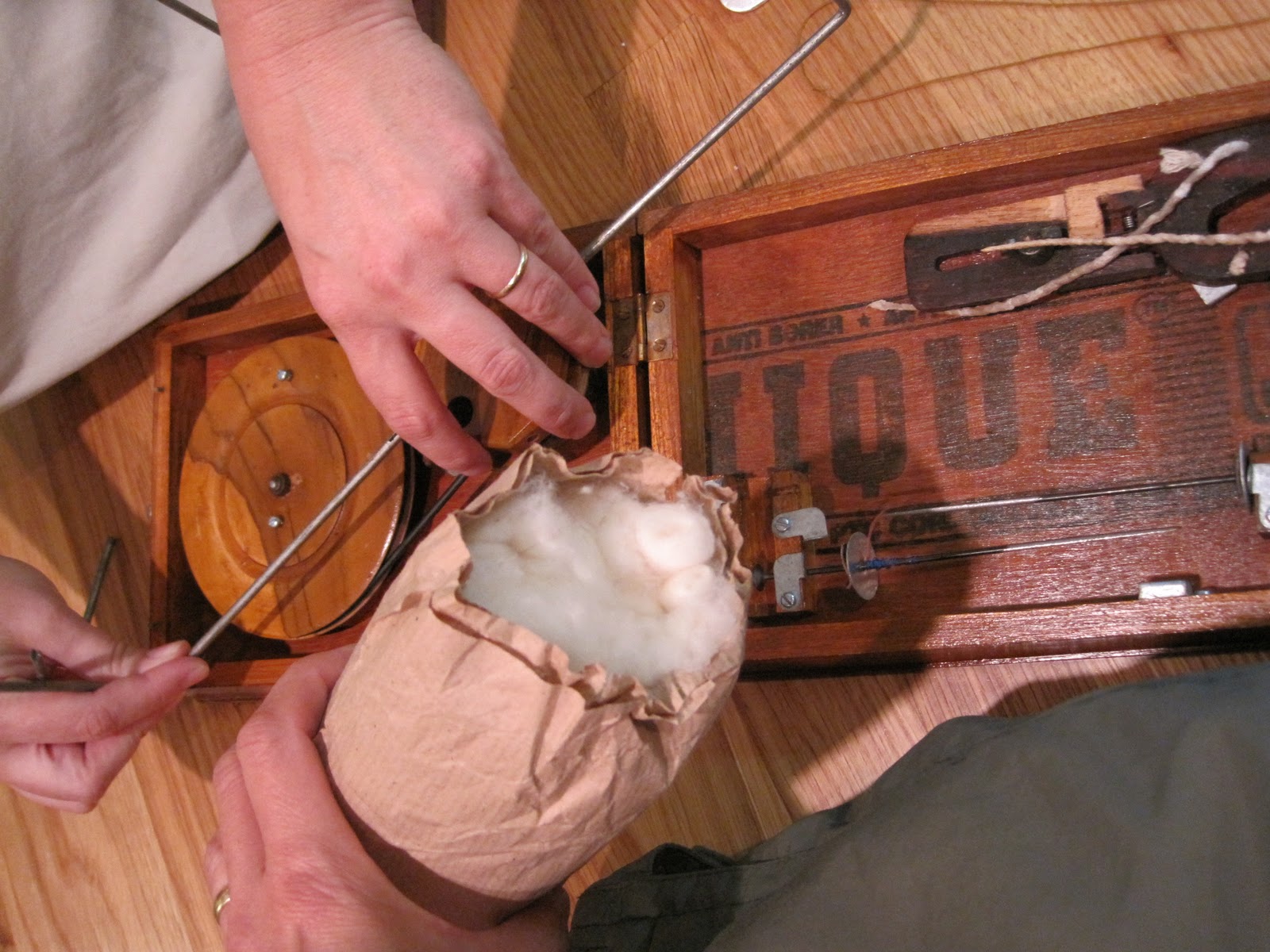
Spinnity's Book Charkha
Spinnity showed me a marvelous thing called a Charkha.

The charkha embodies the utility of industrial engineering design as a linchpin to global and local economics and social change.

During the turn of the century, India, which was under British colonial rule, produced cotton and exported it to Britian, who produced fabric and clothing and sold it back to India at a cost higher than India could afford. Gandhi saw that India could become more self-sufficient if they produced fabric from their own cotton.


Charkha: setting the spindle
In order to do so, spinning cotton fiber was essential. The charkha is a compact spinning device that rose in prominance when Gandhi promoted its use amongst the populace: anyone and everyone could spin fiber.

The charkha is a design marvel. It is compact, lightweight and very portable. Components are made of readily available, easily malleable and replaceable material. The drive-to-output ratio is extremely high, about 1:100; there is an efficient use of energy input to output.
Charkha: spinning
Charka: winding on


Charkha: poonis and setting the reel
Charkha: reel in motion


Spinnity's Book Charkha


The charkha contains a world in itself.

Monday, October 18, 2010

Confiture: Pumpkin (warm circles)

Modelled and inspired by Mes Confitures by Christine Ferber.  The kitchen scale is indispensible.  1-2/3 recipes yields 7 cups.

Peeled and finely diced pumpkin macerates overnight with sugar, lemon, and honey. Have you ever tried to peel a raw pumpkin without slitting your thumbs open?

Simmer - the sugar permeates the pumpkin. Then macerate overnight AGAIN.

Lemons are prepped and candied in caramelized sugar.

Tres cher.

Sugar, pumpkin, honey, sugar, lemon, sugar and time.

Wednesday, October 13, 2010

Green Tomatoes

When a cool summer leaves you with green tomatoes in October, make pickles! 12 pints!

Throw the green ones into jars with vinegar, salt, garlic, bay, and some seeds.

And throw the ripe ones into a pot with some protein and cook them down.  Don't even cut them; smash them with a slotted spoon as they pop open from the heat.

Friday, September 24, 2010

September 23 moon

Let's take a moment to observe the harvest moon: the full moon that occurs closest to the autumn equinox, typically September 22 or 23. This year the full moon and equinox nearly coincide, a truly remarkable and auspicious event.

Thursday, September 23, 2010

New things, native and not

While on an island a month ago, I saw three new things. Because they were new to me, I assumed that they were native to the island, but I later learned that only one of them is.

Thing 1: I purchased this beautiful heavy fruit from a roadside stand. "Dragonfruit" came with no operating instructions so I cut it open and was amazed when I saw the beautiful seed speckles scattered in the cool white flesh. I peeled off the skin which separated easily from the fruit, then ate some, then ate it all - no one else would touch it. It's slightly sweet and tastes a little like kiwi. Later I learned that this is pitaya, the fruit of a cactus (just as prickly pear is also a cactus fruit) and originated in asia.

Thing 2: While traveling along on the east side of the island, I saw stands of tall trees with elegant top canopies. The trunks splayed from the center and were fairly straight, and looked like they would be useful as poles. Later I learned that these are albizia trees, which thrive in sub-tropical climates and can grow 15 feet in one year! They are not native to this island - indeed they could be invasive - we'd better find a use for them!


Thing 3: "What are Canadian geese doing on this island, thousands of miles away from Canada?" was the first comment we uttered when we saw these birds strolling. We soon learned that these are nene, Hawaii's endemic geese listed on the endangered species list. I am very fortunate to have seen these.

Wednesday, September 22, 2010

Summer - Forever

What happens when nature follows her own inclination? Rampant growth, with explosions of seed tufts that stick to nearby surfaces.

This is a horrific sight when the dandelion-type plants are nearly as tall as I am.

It's doubly horrific when the nearby patch of tomatoes growing in rich soil amended with "home-grown" compost is less than a fallen weed-stalk away. What we don't see are the weeds that were growing right next to these tomatoes; I pulled out those fluffy-seedy weeds about a month ago.


I pulled up the weeds we see in these images about two weeks ago. But the grey fuzz of sticky seed fluff is nearly impossible to hand-pick out of the soil and nearby plants. I considered using fire but could not think of an effective method that would not put the house and neighborhood at risk. I'm doomed to hyper-vigilant scrutiny for weed growth. Forever. All because I let these damn things metastasize.

Tuesday, September 21, 2010

Nani 'a'a pulu niu


I was washed up onto an island a month ago and there were coconut palms everywhere.


Did I hear the roar of the ocean or the palm fronds rattling in the wind?


A walk along the beach yielded different parts of the plant, specifically the nuts at young and old stages, as well as fronds that fell from the tall trunks that swayed in the warm breeze.


The fibrous husks are fascinating.

These are the fibers in a young immature coconut.


These are the fibers in a large older husk that surrounds a coconut.


Layers of fibers that cross each other form a fabric that anchors the base of the palm frond to the trunk.

Hawaiians use coconut fiber. The fiber is spun and plied into cord. Thin cord is tied and knotted into nets used for fishing and nets used to carry items. Thicker cord is used to lash bamboo framework together for shelter. I need to learn more about this.

I'd love to see how this plant grows, especially how the fibers and the crossing layers develop. Slo-mo, please!